


AS1940:2017 Compliance Reference
Complete guide to separation distances for flammable and combustible liquid storage under Australian Standard AS1940:2017.
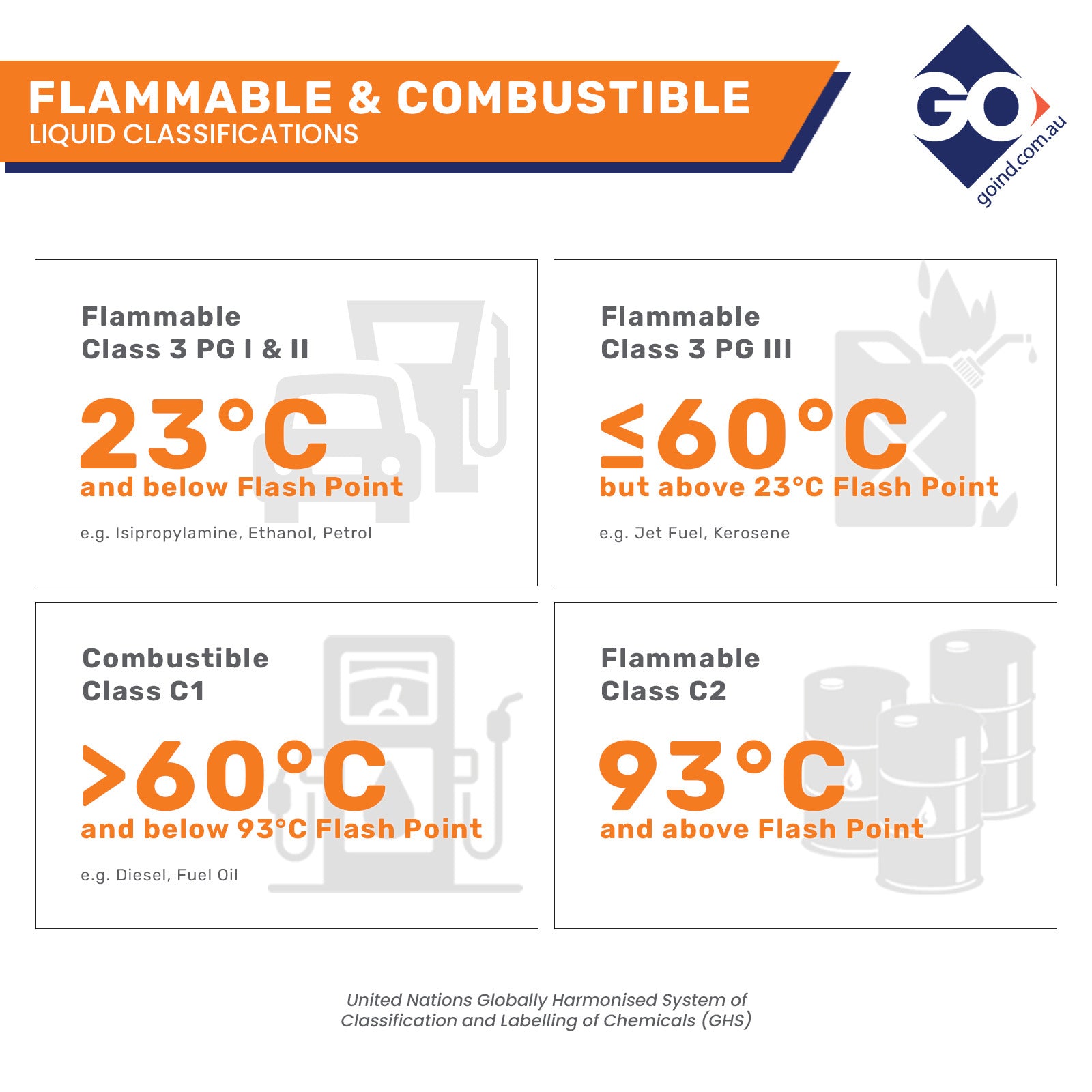
Flammable & Combustible Liquid Classification
AS1940:2017 — The storage and handling of flammable and combustible liquids — is the Australian Standard that governs how fuel must be stored, including minimum separation distances from buildings, boundaries, and other tanks. These distances vary based on the class of liquid, tank capacity, and tank configuration.
Flammable liquids (Class 3) have a flash point below 61°C and include petrol, aviation fuel, and solvents. Combustible liquids have a flash point at or above 61°C and include diesel (Class C1) and lubricating oils (Class C2). Diesel is classified as combustible, not flammable — a common misconception that affects distance calculations.
AS1940 Section 5
Horizontal Tanks
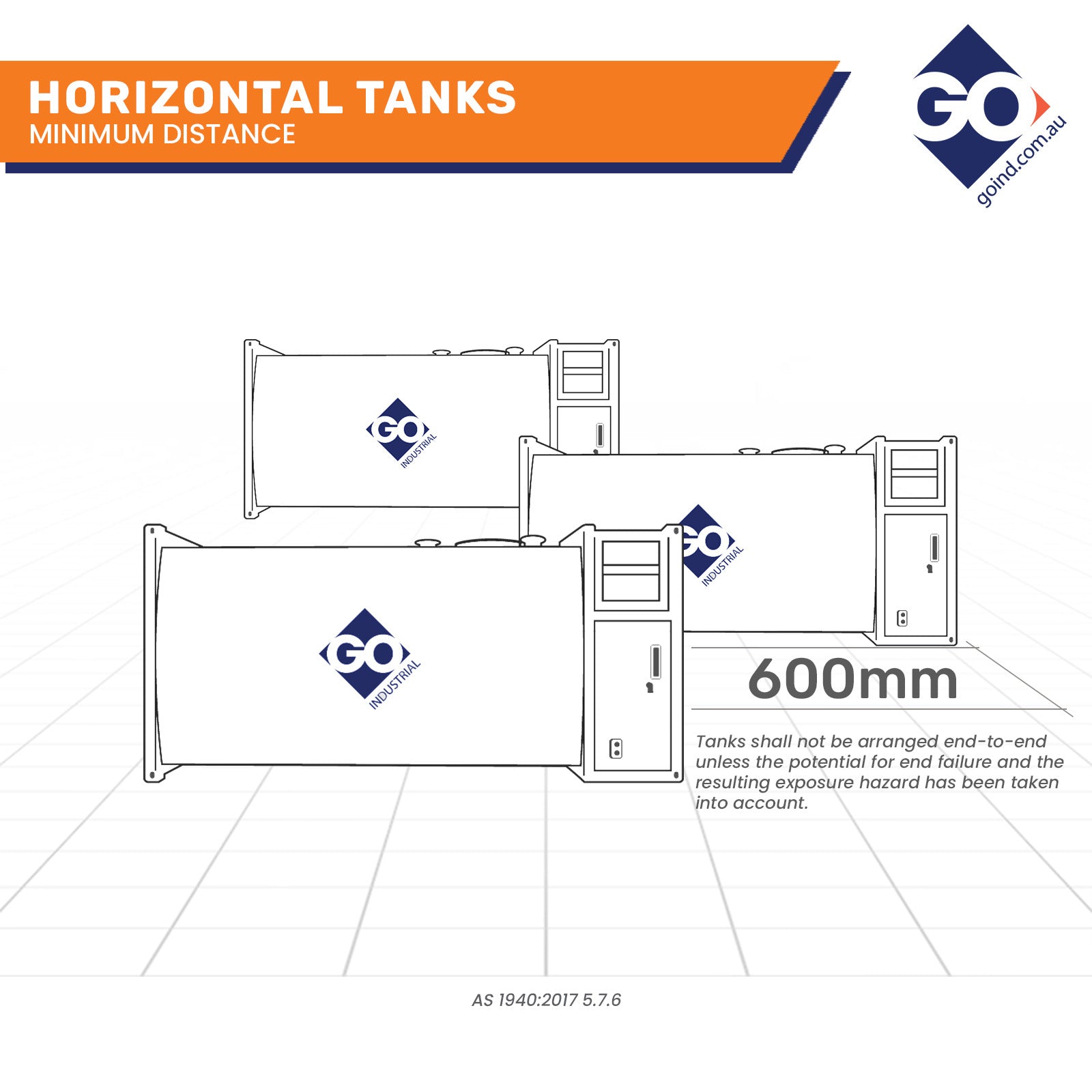
Horizontal self bunded tanks are the most common configuration for above ground diesel and petrol storage. AS1940 specifies separation distances based on aggregate capacity of all tanks in a group and the class of liquid stored.
The diagram shows minimum clearances required from the tank to property boundaries, protected places (dwellings, schools, hospitals), adjacent tanks, and buildings on the same property. Self bunded tanks with 110% integrated bunding simplify compliance by eliminating the need for separate bund walls.
AS1940 Section 5
Vertical Tanks
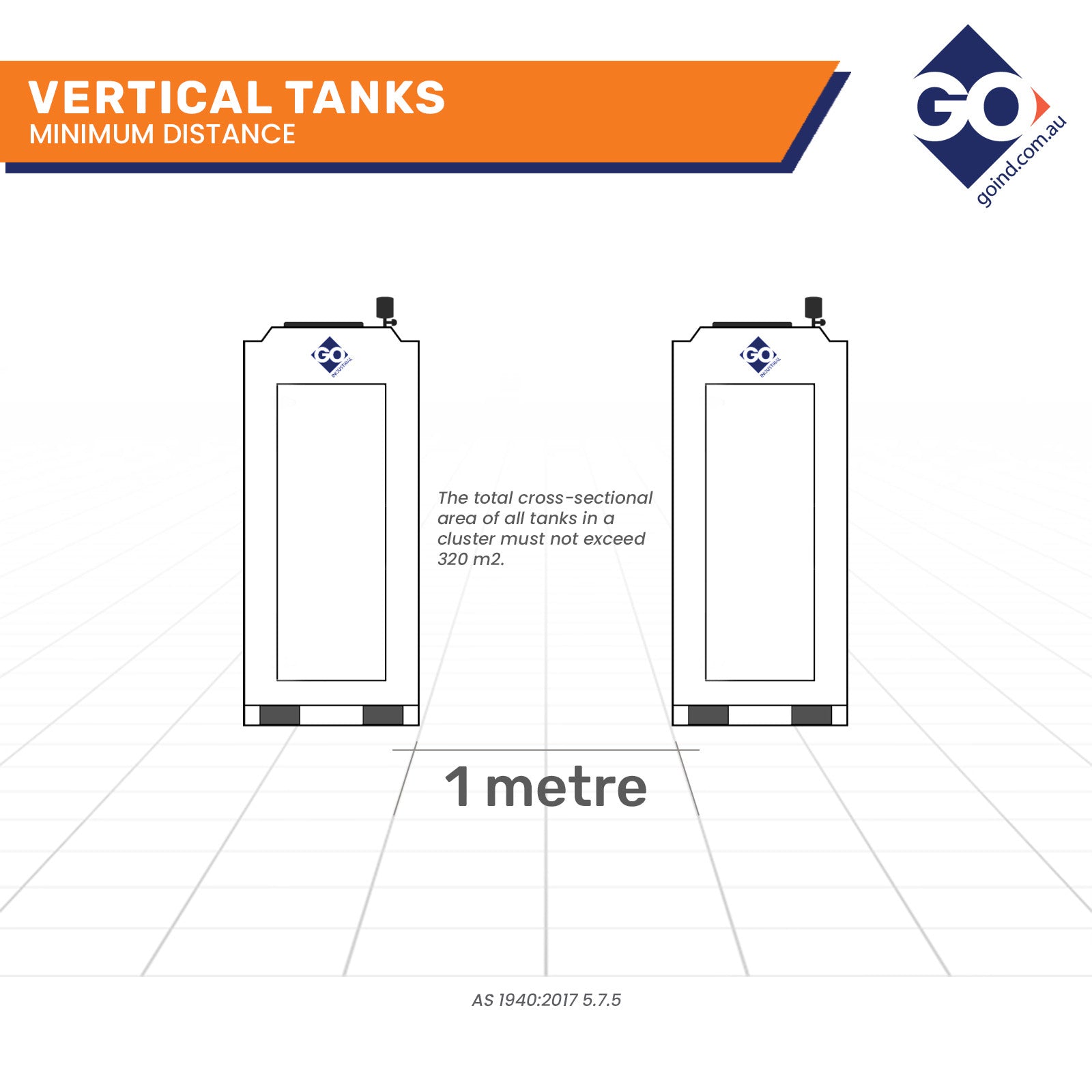
Vertical tank installations have different footprint characteristics that affect separation distance requirements. While the capacity-based distance rules remain the same, vertical tanks typically require additional consideration for overhead clearance, fill point access, and vent pipe termination heights.
The diagram illustrates minimum clearances for vertical above ground tank configurations, including distances to boundaries, buildings, and protected places.
AS1940 Section 5.5
Tanks Inside Buildings
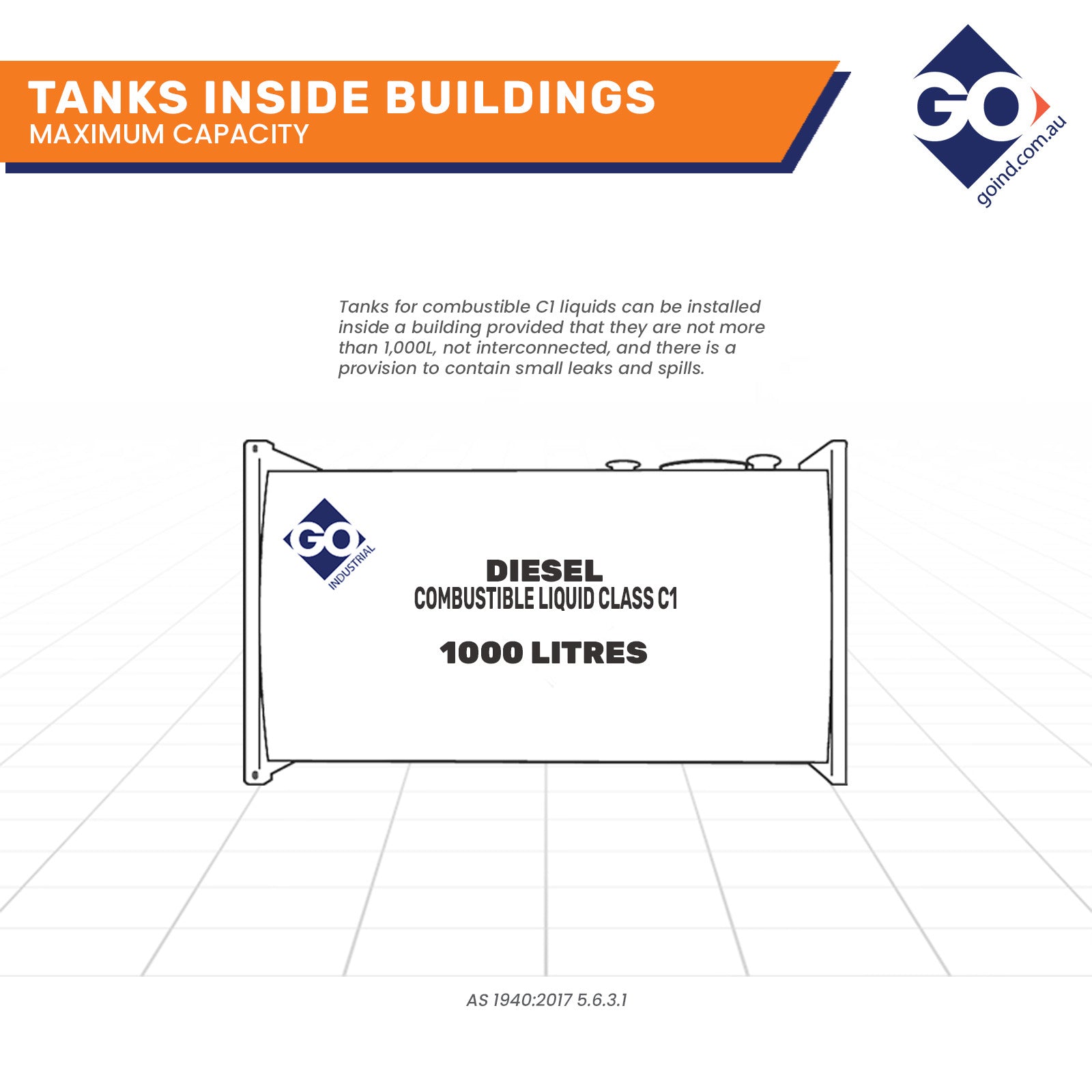
Fuel storage inside buildings is permitted under AS1940 with additional requirements for ventilation, fire separation, and spill containment. Indoor installations are limited by aggregate capacity and the class of liquid stored.
The diagram shows the specific requirements for enclosed installations, including ventilation rates, fire-rated wall construction, and maximum permissible storage volumes within structures.
AS1940 Section 5.12
On Construction Sites
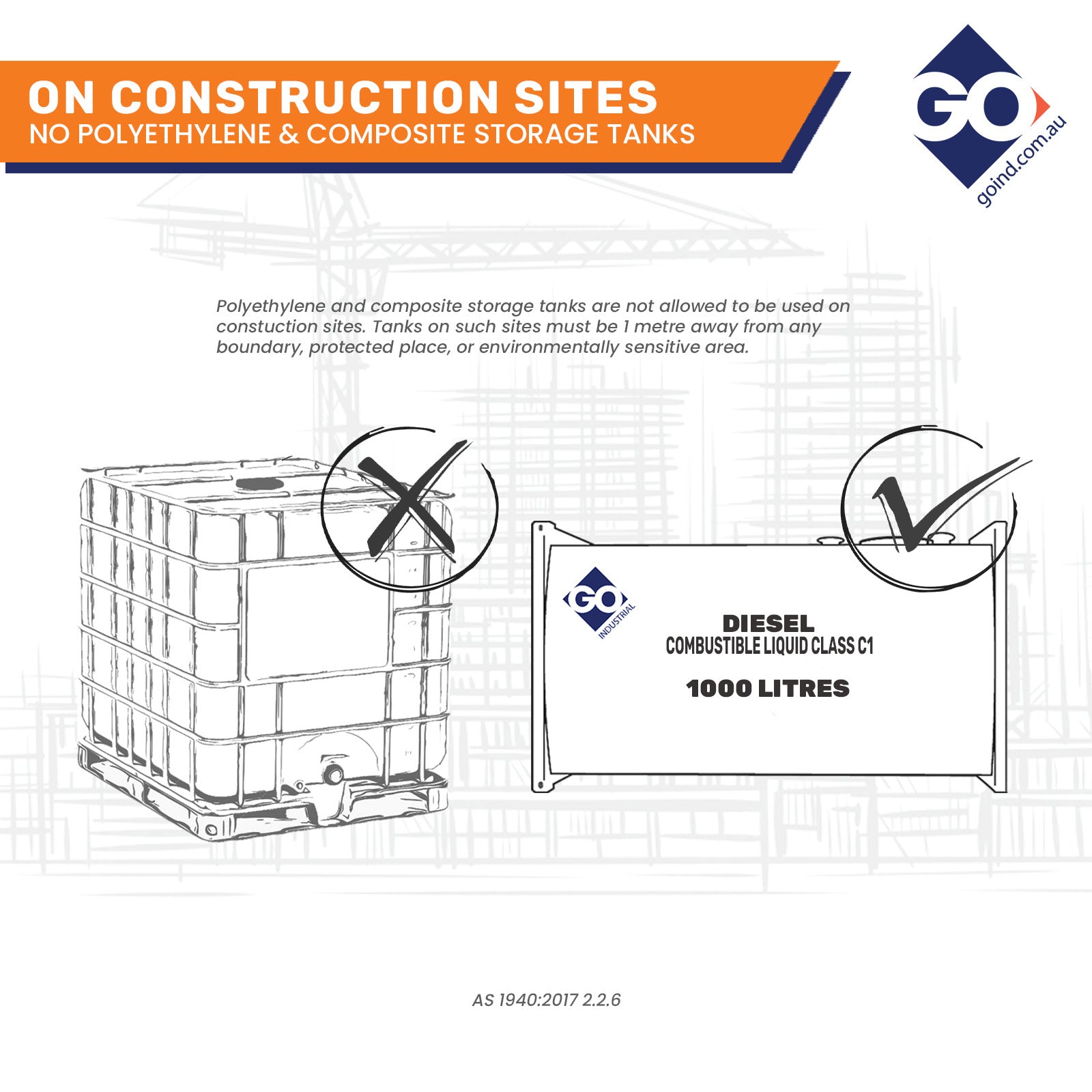
Temporary fuel storage on construction sites is governed by Section 5.12 of AS1940. Self bunded tanks are the preferred solution for construction sites due to their integrated bunding, relocatability, and reduced civil works requirements.
The diagram outlines separation distances and special conditions applicable to construction and demolition sites, including reduced requirements for temporary installations under 12 months.
AS1940 Section 5.8
Ignition Sources
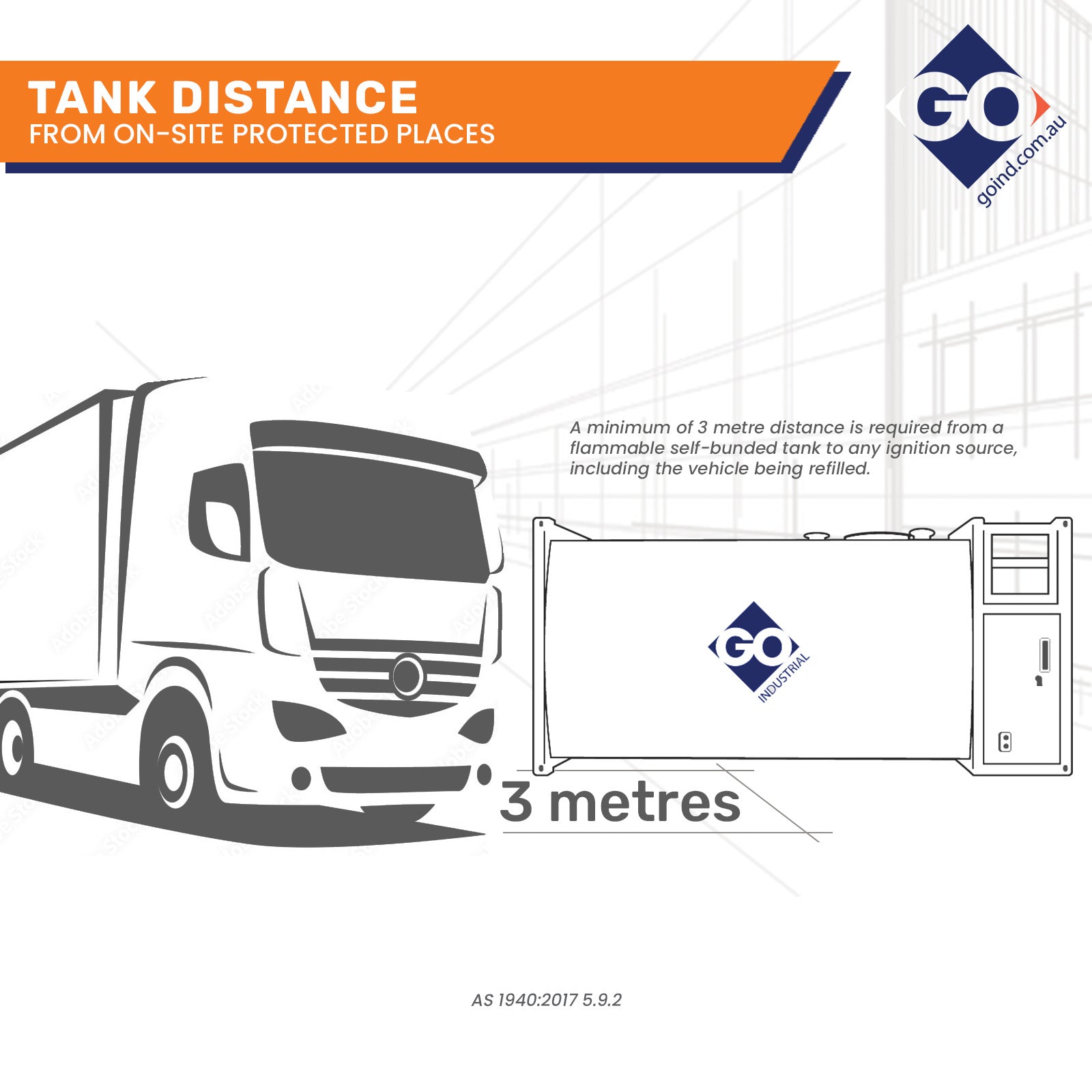
AS1940 requires specific separation distances between fuel storage and potential ignition sources — including electrical switchboards, engines, welding equipment, and open flames. The hazardous zone around a fuel tank is defined by the class of liquid and the tank’s ventilation arrangement.
This diagram identifies common ignition sources and the minimum distances required to maintain safe operations around fuel storage installations.
Minor Storage Provisions
AS1940 provides simplified requirements for minor storage — defined as aggregate quantities below 5,000L for combustible liquids (Class C1) or below 1,000L for flammable liquids (Class 3). Many small-to-medium operations fall within these thresholds, allowing reduced compliance requirements while maintaining essential safety standards.
AS1940 Section 2.3
Minor Storage Exemptions
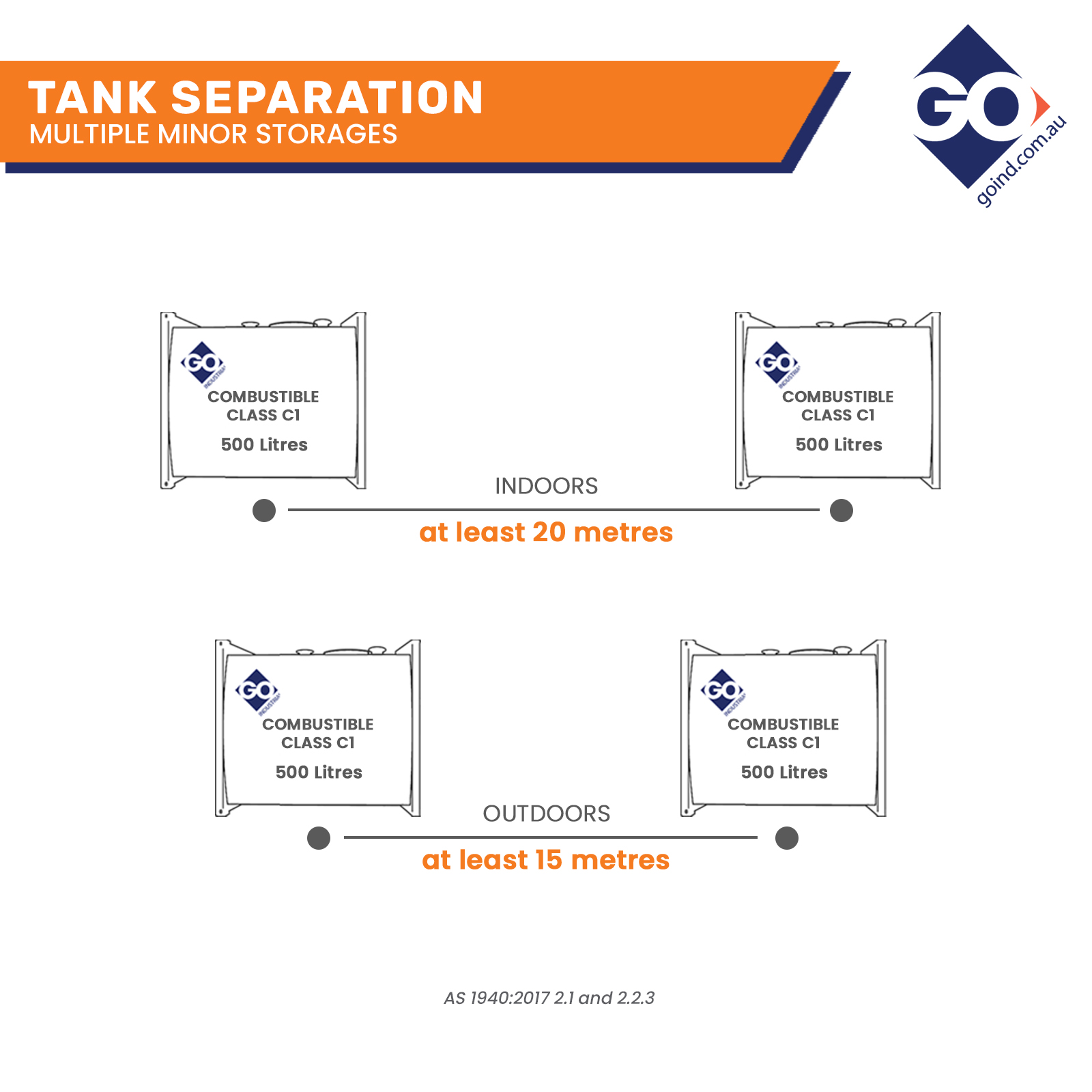
The diagram details the specific exemptions and reduced requirements available for minor storage quantities under AS1940. These exemptions cover separation distances, bunding requirements, and fire protection provisions for smaller installations.
Note: even under minor storage provisions, basic requirements for spill containment, signage, and fire extinguisher access still apply.
Distance Requirements by Fuel Class
Separation distances vary significantly based on the class of liquid being stored. The following sections detail the specific distance requirements for each fuel classification as defined in AS1940:2017.
Flammable Liquid
Class 3 Packing Group II — Petrol
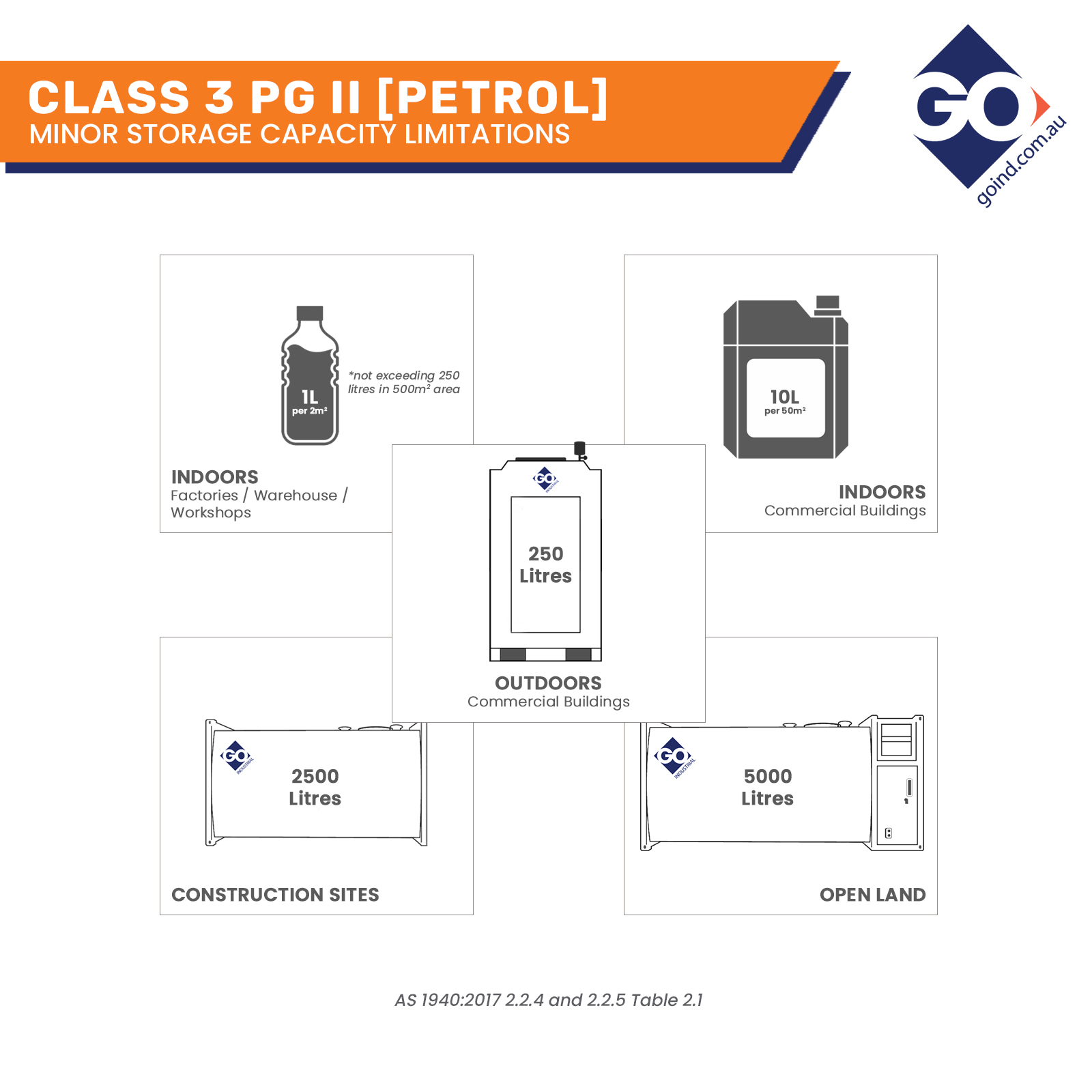
Petrol (gasoline) is classified as a Class 3 Flammable Liquid, Packing Group II, with a flash point below 23°C and boiling point above 35°C. This classification carries the most stringent distance requirements under AS1940 due to the high vapour pressure and ignition risk.
The infographic shows the specific separation distances required for petrol storage at various tank capacities.
Flammable Liquid
Class 3 Packing Group III — Jet Fuel & Kerosene
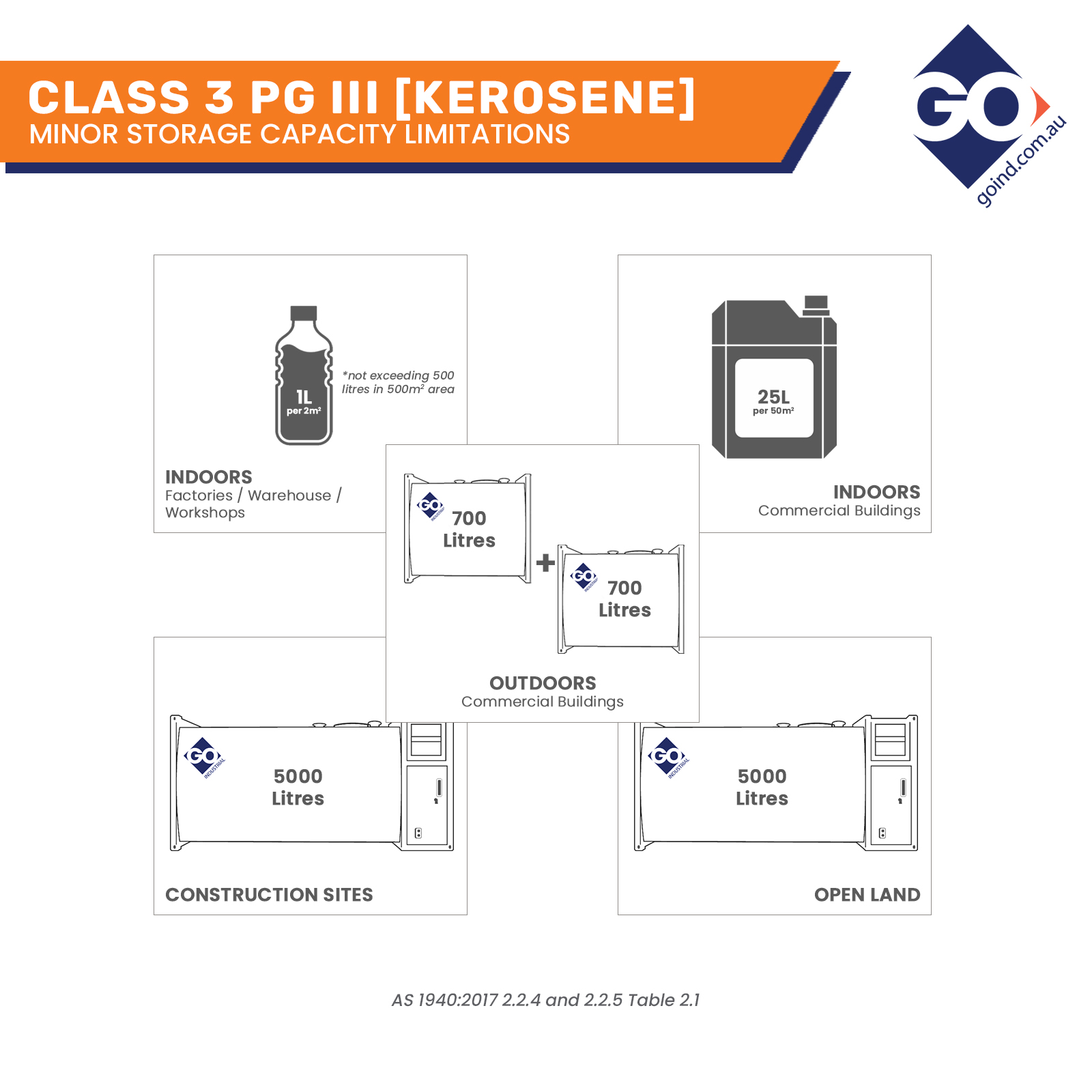
Jet fuel and kerosene are classified as Class 3 Flammable Liquids, Packing Group III, with a flash point between 23°C and 60°C. While still classified as flammable, PG III liquids have reduced vapour pressure compared to petrol, resulting in moderately reduced separation distances.
The infographic details the distance requirements specific to PG III flammable liquid storage.
Combustible Liquid
Class C1 & C2 — Diesel & Lubricating Oil
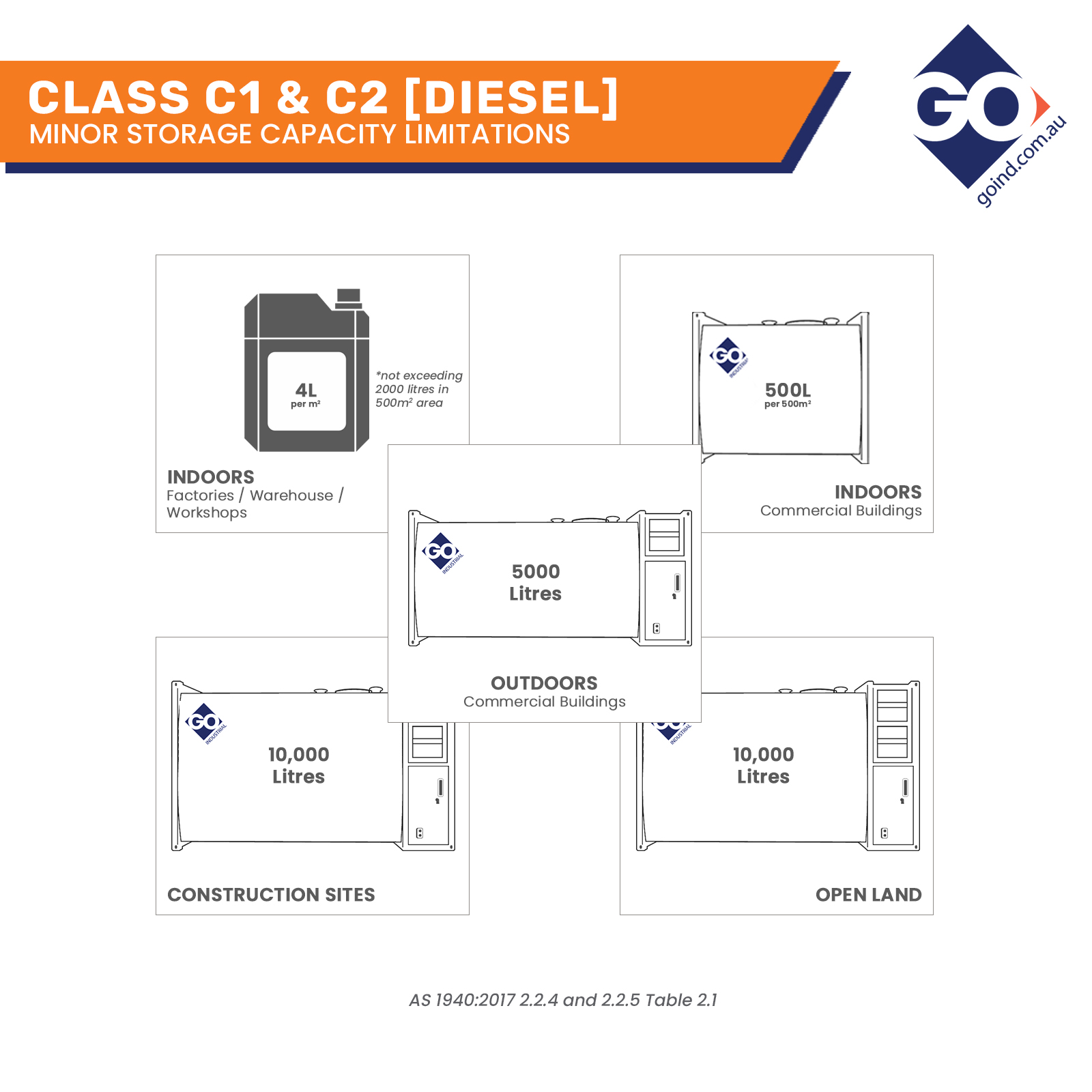
Diesel fuel is classified as a Class C1 Combustible Liquid with a flash point between 61°C and 150°C. Lubricating oils and heavy fuel oils are typically Class C2 (flash point above 150°C). Combustible liquids carry significantly reduced separation distances compared to flammable liquids.
The infographic shows the distance requirements for both C1 and C2 combustible liquid storage — the most common classification for self bunded tank installations.
AS1940 Table 5.3
Separation Distances Overview
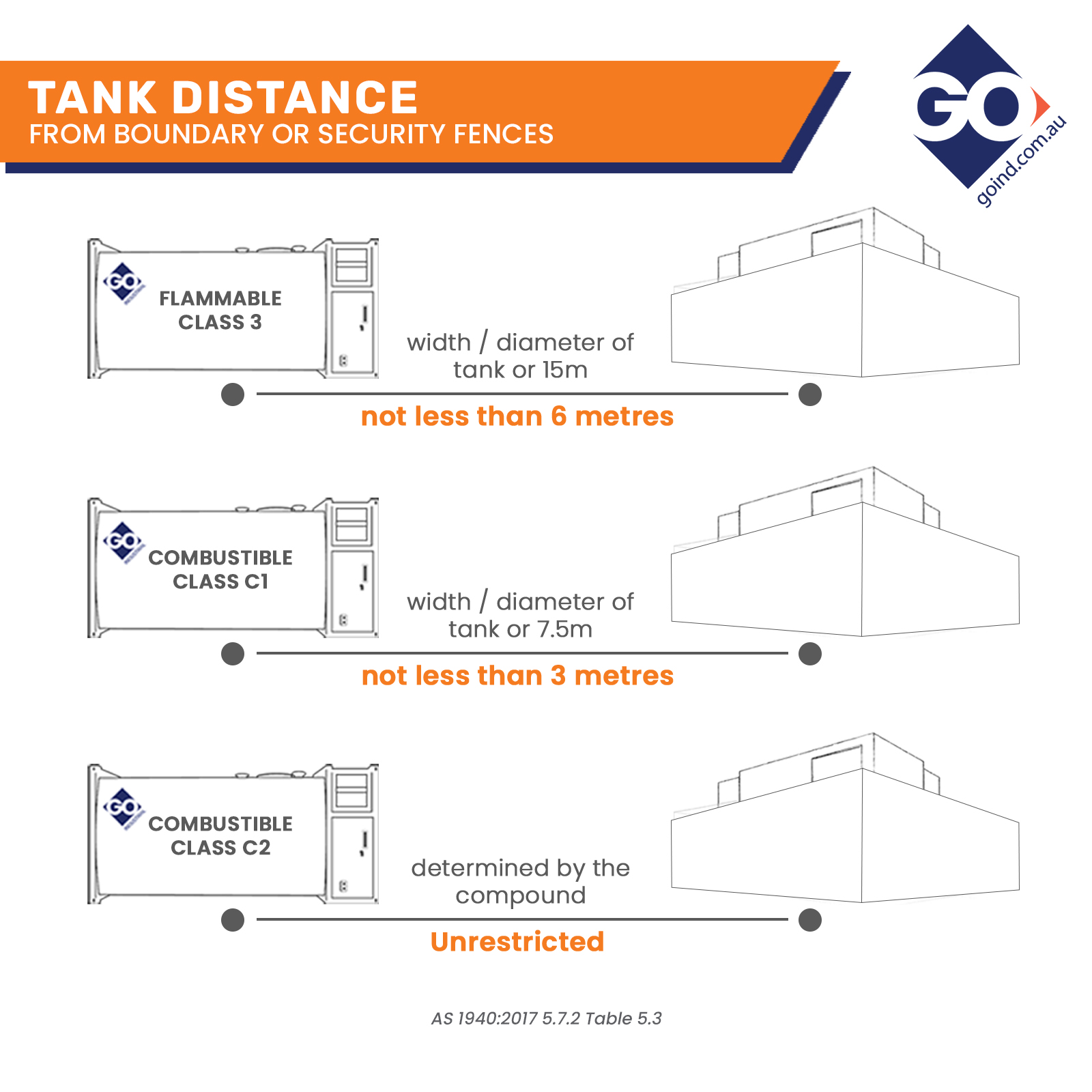
This diagram provides a consolidated overview of AS1940 Table 5.3 separation distance requirements across all liquid classes and tank capacities. It shows the four key distance measurements: from protected places, from property boundaries, from other tanks, and from buildings on the same property.
Fire-rated self bunded tanks (tested to UL2085 / AS1940 Section 5.7) may qualify for reduced separation distances — in some cases up to 50% reduction.
Boundary & Property Line Distances
The following sections detail the minimum distances required between fuel storage tanks and property boundaries or security fences, broken down by fuel classification.
Class 3 PG I & II
Petrol — Boundary Distances
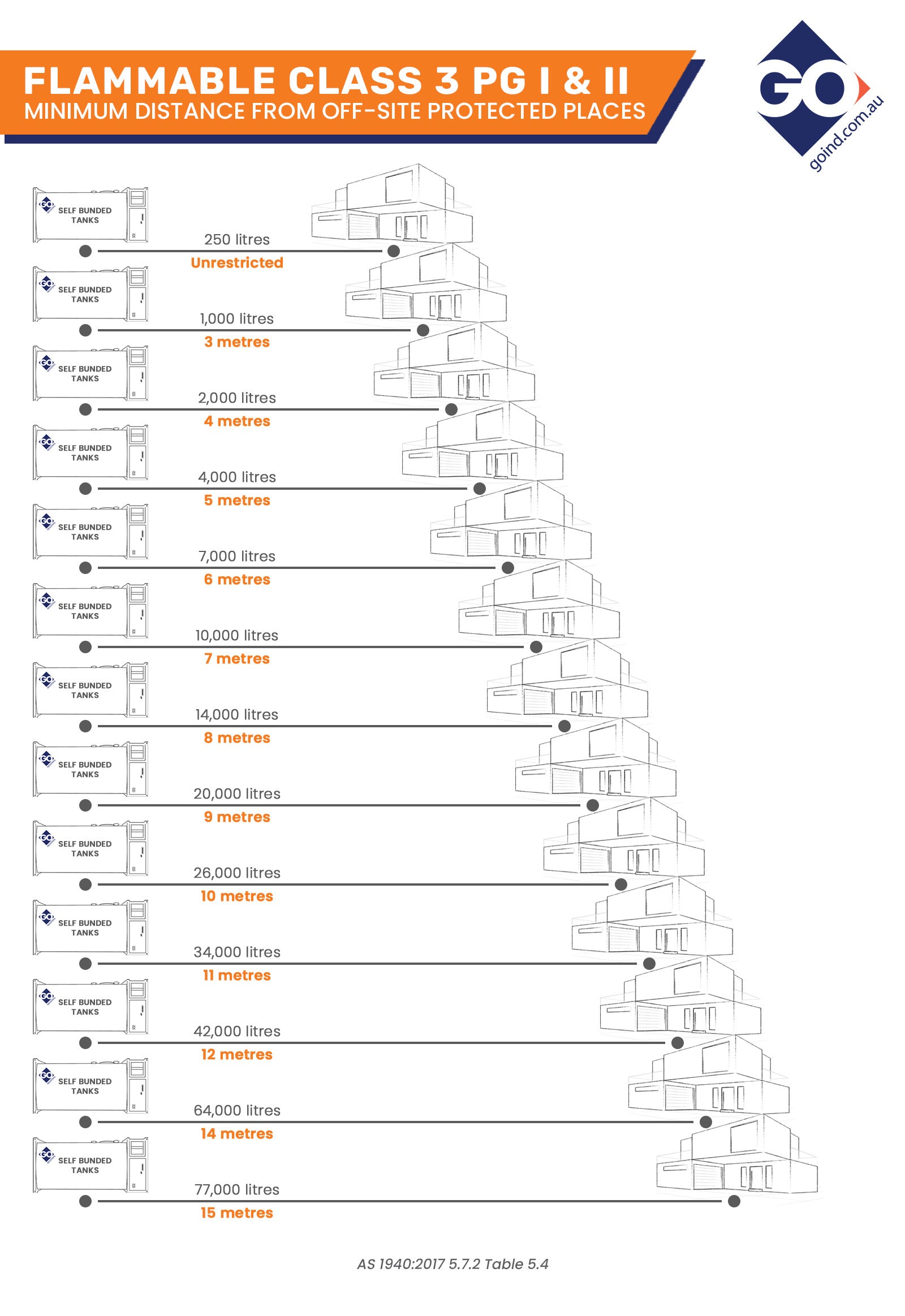
Petrol storage requires the greatest boundary separation distances under AS1940 due to its high vapour pressure and low flash point. The minimum distance from a property boundary is determined by the aggregate capacity of all Class 3 PG II tanks on site.
The diagram shows boundary distance requirements at each capacity threshold for petrol and equivalent Class 3 PG I & II flammable liquids.
Class 3 PG III
Jet Fuel — Boundary Distances
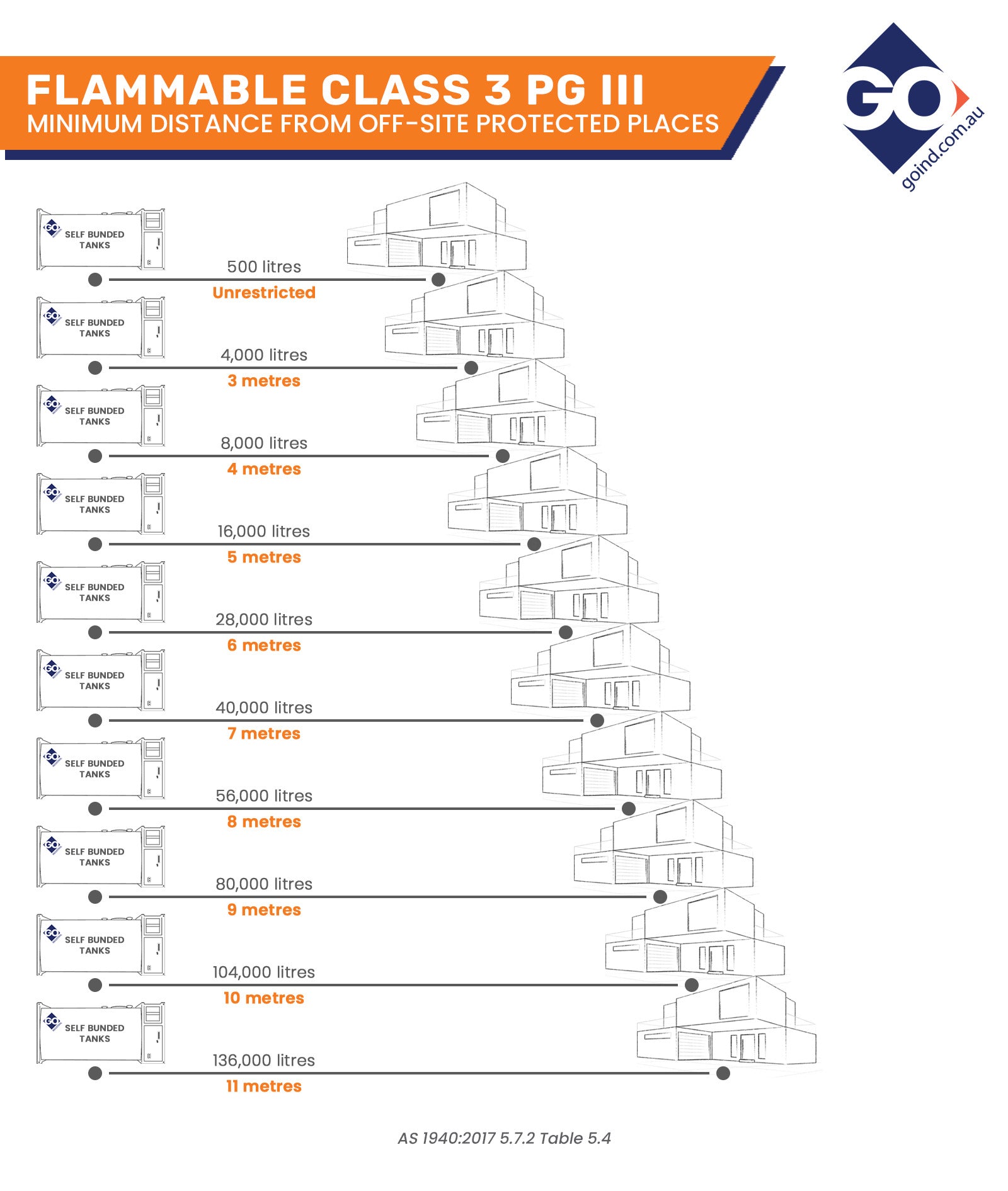
Jet fuel, kerosene, and other PG III flammable liquids have moderately reduced boundary distance requirements compared to petrol. The flash point range of 23–60°C results in lower vapour concentrations at ambient temperature.
The diagram details boundary separation distances for Class 3 PG III flammable liquid storage at each capacity threshold defined in AS1940.
Combustible C1
Diesel — Boundary Distances
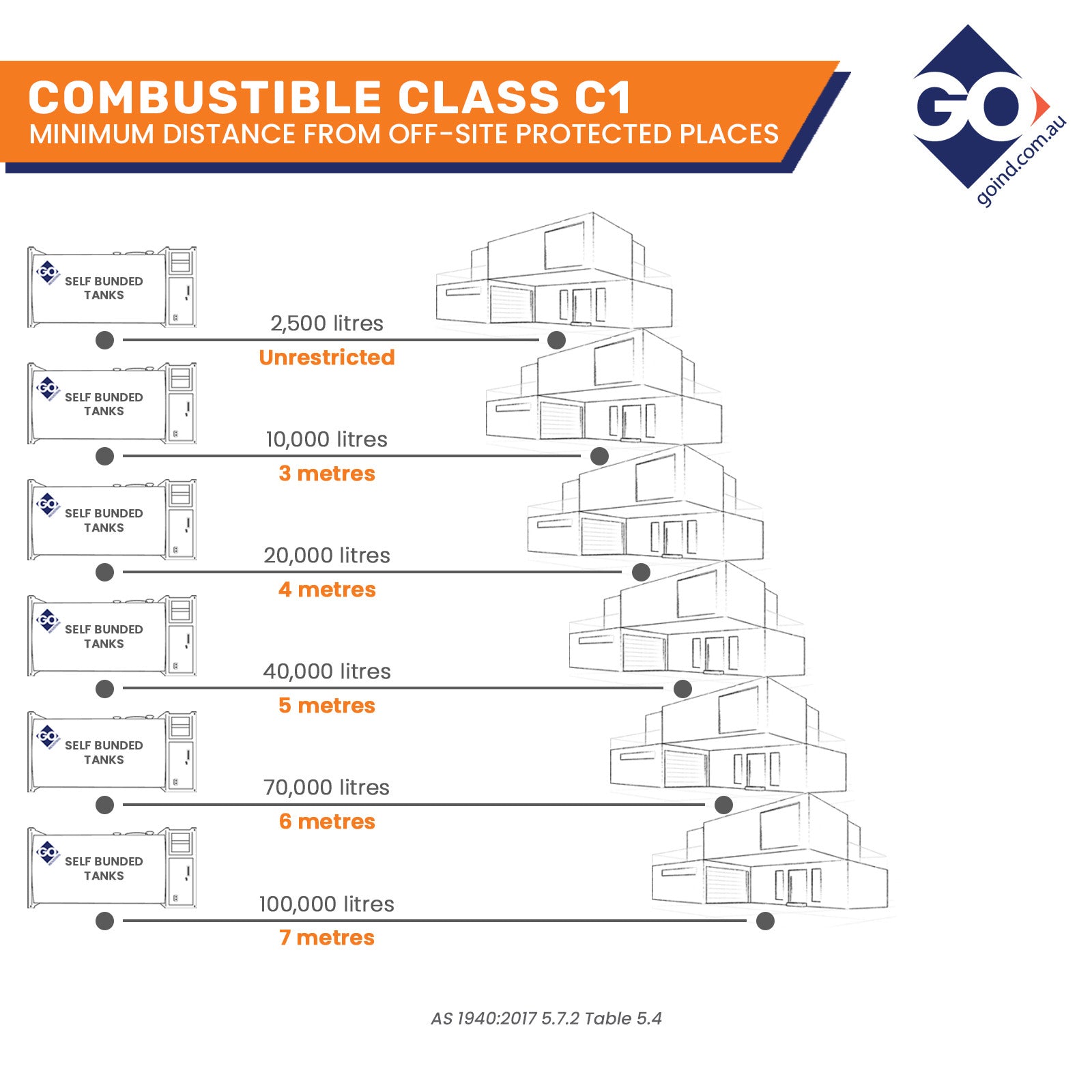
Diesel (Class C1) has significantly reduced boundary distance requirements compared to flammable liquids. With a flash point above 61°C, diesel produces minimal vapour at ambient temperatures, reducing both ignition risk and required separation distances.
The diagram shows boundary distances for Class C1 combustible liquid storage — the most common fuel type stored in self bunded tanks across Australian sites.
Combustible C2
Lubricating Oil — Boundary Distances
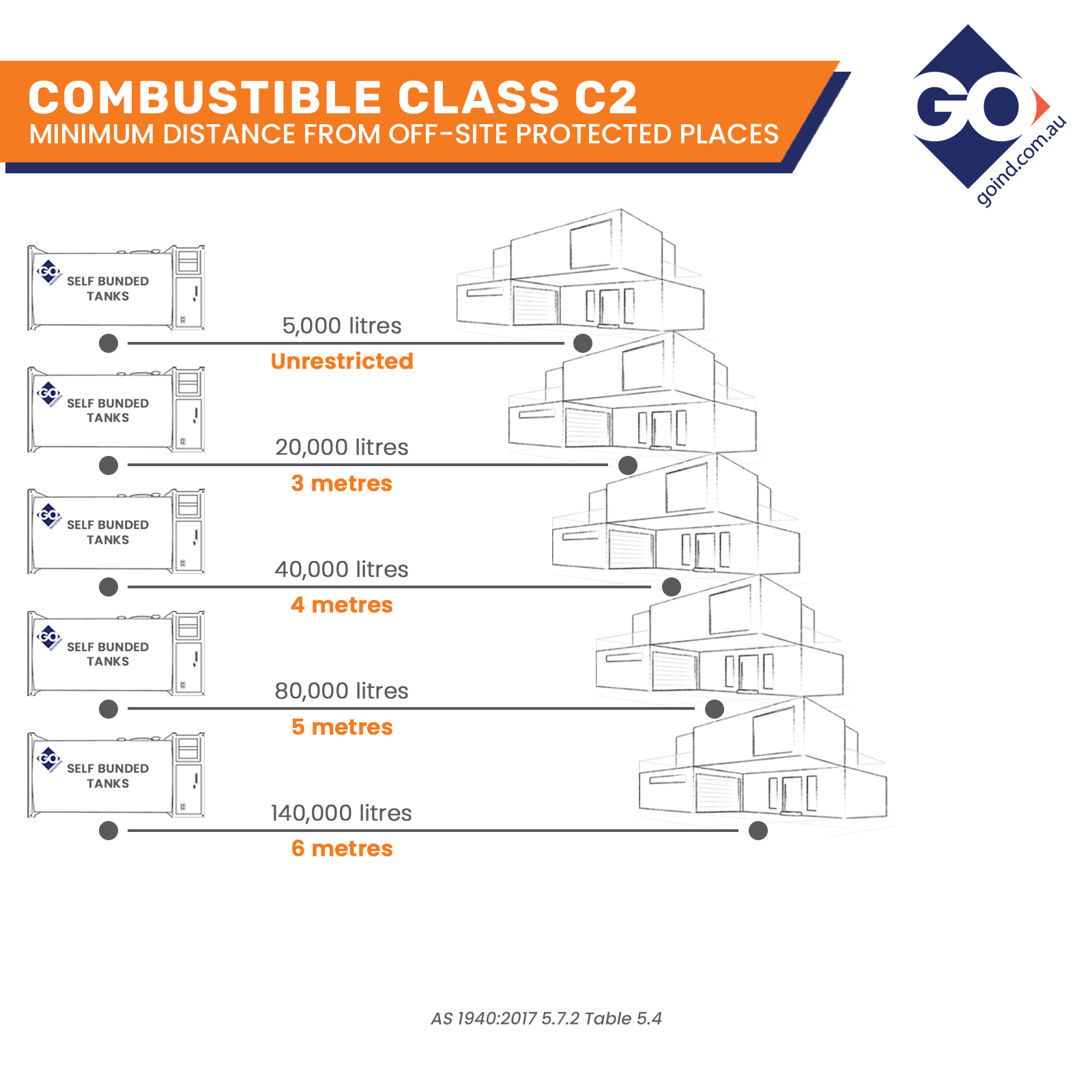
Class C2 combustible liquids (flash point above 150°C) — including lubricating oils, hydraulic fluids, and heavy fuel oils — carry the lowest boundary distance requirements under AS1940. The high flash point means these liquids pose minimal vapour ignition risk.
The diagram shows boundary distances for Class C2 combustible liquid storage at each capacity threshold.
AS1940 Section 5.4
On-Site Protected Places
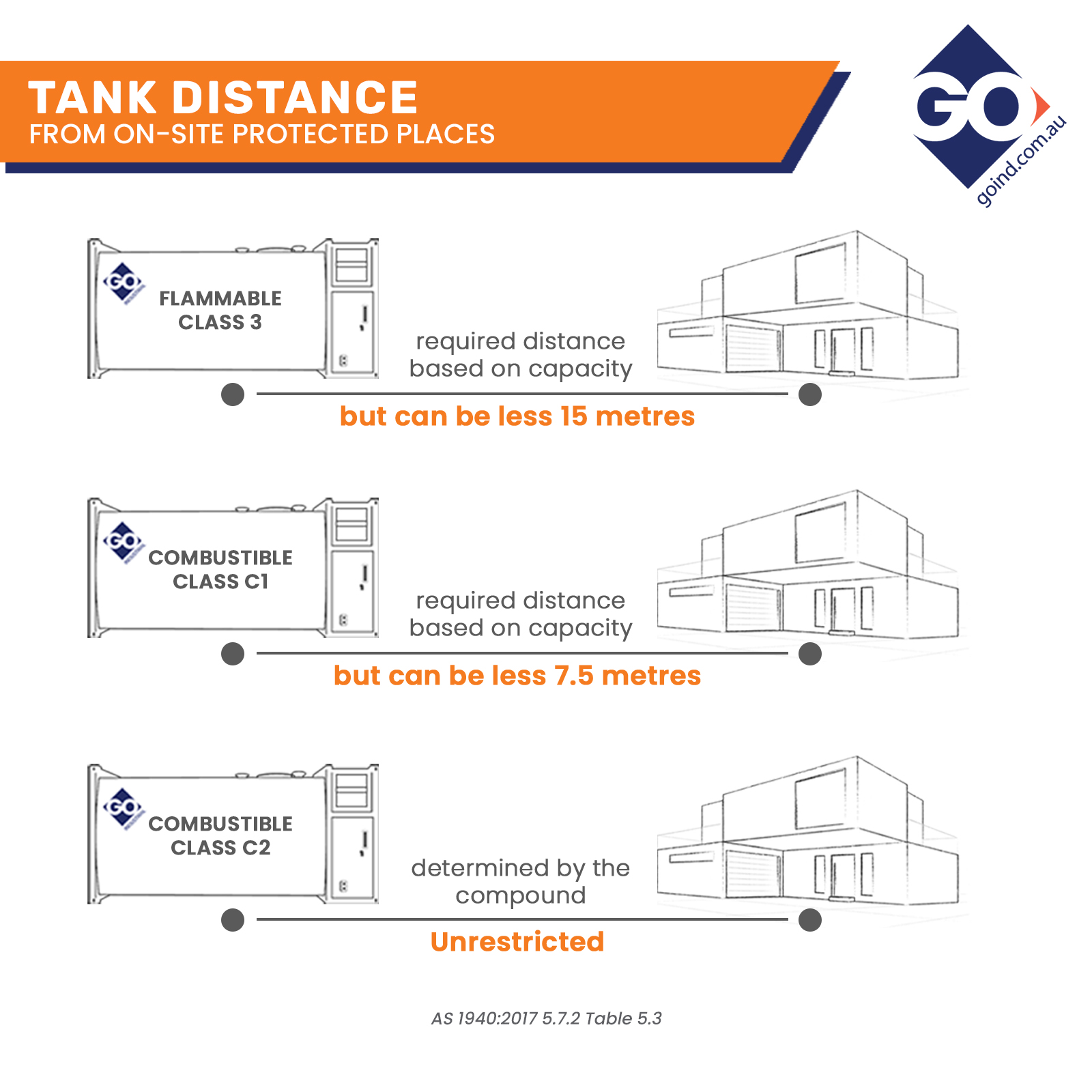
Protected places include any building or area where people congregate — offices, lunchrooms, workshops, accommodation, schools, hospitals, and retail premises. AS1940 requires the greatest separation distances from these locations.
This diagram shows the specific requirements for on-site protected places, which often represent the most challenging distance constraint for fuel storage installations. Self bunded tanks with fire-rating certification can significantly reduce these distances.
AS1940 Section 5.9
Tank Clustering — Vertical Configuration
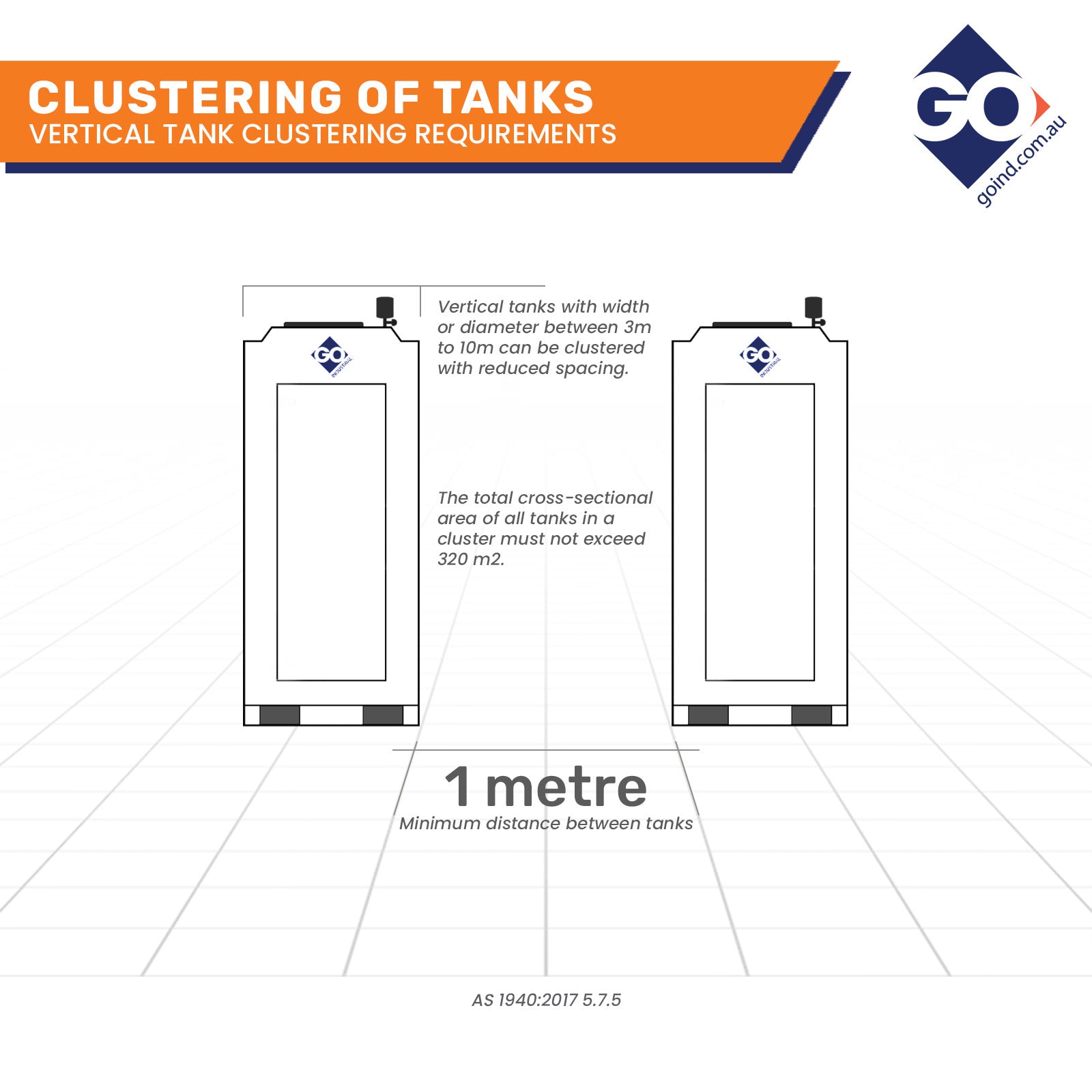
When multiple tanks are installed within 1 metre of each other, they are considered a ‘cluster’ under AS1940. The total aggregate capacity of all tanks in the cluster determines the separation distances to boundaries and protected places.
This diagram illustrates the clustering rules for vertical tank arrangements, including maximum cluster volumes and inter-tank spacing requirements.
AS1940 Section 5.9
Tank Clustering — Horizontal Configuration
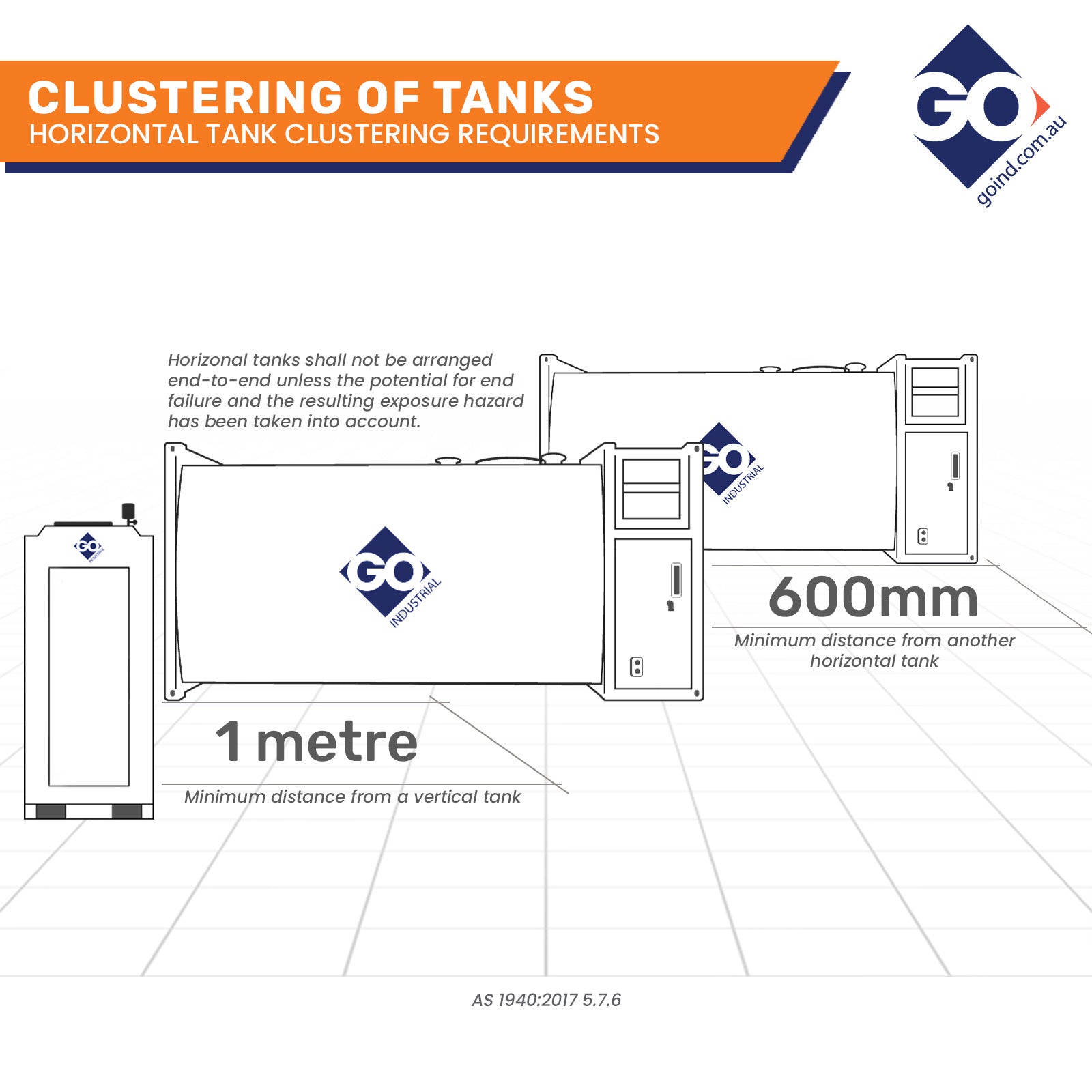
Horizontal tank clusters follow the same aggregate capacity rules as vertical clusters. The diagram shows inter-tank spacing, maximum cluster widths, and the impact of clustering on separation distances to surrounding features.
Planning your tank layout with clustering rules in mind can optimise site utilisation while maintaining full AS1940 compliance. Our installation team can assist with site layout planning.
AS1940:2017
Current Standard
590+
Monthly Searches
Class 3 & C1/C2
All Classifications Covered
Frequently Asked Questions
Common questions about AS1940 separation distance requirements for fuel storage in Australia.
For diesel (Class C1 combustible liquid), minimum separation distances depend on aggregate tank capacity. A single tank up to 2,500L requires 3m from protected places and 1.5m from boundaries. Larger installations require greater distances per AS1940 Table 5.3. Fire-rated tanks may qualify for reduced distances.
Yes. Self bunded tanks tested to UL2085 (2-hour fire test) and certified under AS1940 Section 5.7 may qualify for separation distance reductions of up to 50% in certain configurations. GO Fire-Rated tanks carry this certification.
AS1940 provides simplified requirements for aggregate storage below 5,000L of combustible liquids or 1,000L of flammable liquids. Reduced separation distances and simplified bunding requirements apply, though basic safety provisions (signage, fire extinguisher, spill containment) are still mandatory.
Tanks within 1m of each other are considered a cluster. The total aggregate capacity of the cluster determines separation distances. Tanks more than 1m apart are assessed individually. Our AS1940 auditing team can assist with site compliance assessment.
AS1940 is enforced by state and territory work health and safety regulators — WorkSafe Victoria, SafeWork NSW, Workplace Health and Safety Queensland, and equivalents in other states. Non-compliance can result in improvement notices, prohibition notices, and penalties. Insurance underwriters also commonly require AS1940 compliance evidence.
Need an AS1940 Compliance Audit?
Our Site Team delivers photo-documented AS1940 audits covering Sections 4 through 11. Learn more about AS1940 Auditing or call 07 3284 2240 to book.